By Pauline Tamayo
Fossil fuels have helped industries and economies grow for decades, but they have also greatly contributed to climate change and environmental destruction. As countries shift toward cleaner and low-carbon energy sources, many workers and communities that depend on fossil fuel industries face uncertainty regarding their jobs, income, and livelihoods. This is why the idea of a “Just Transition” has become increasingly important.
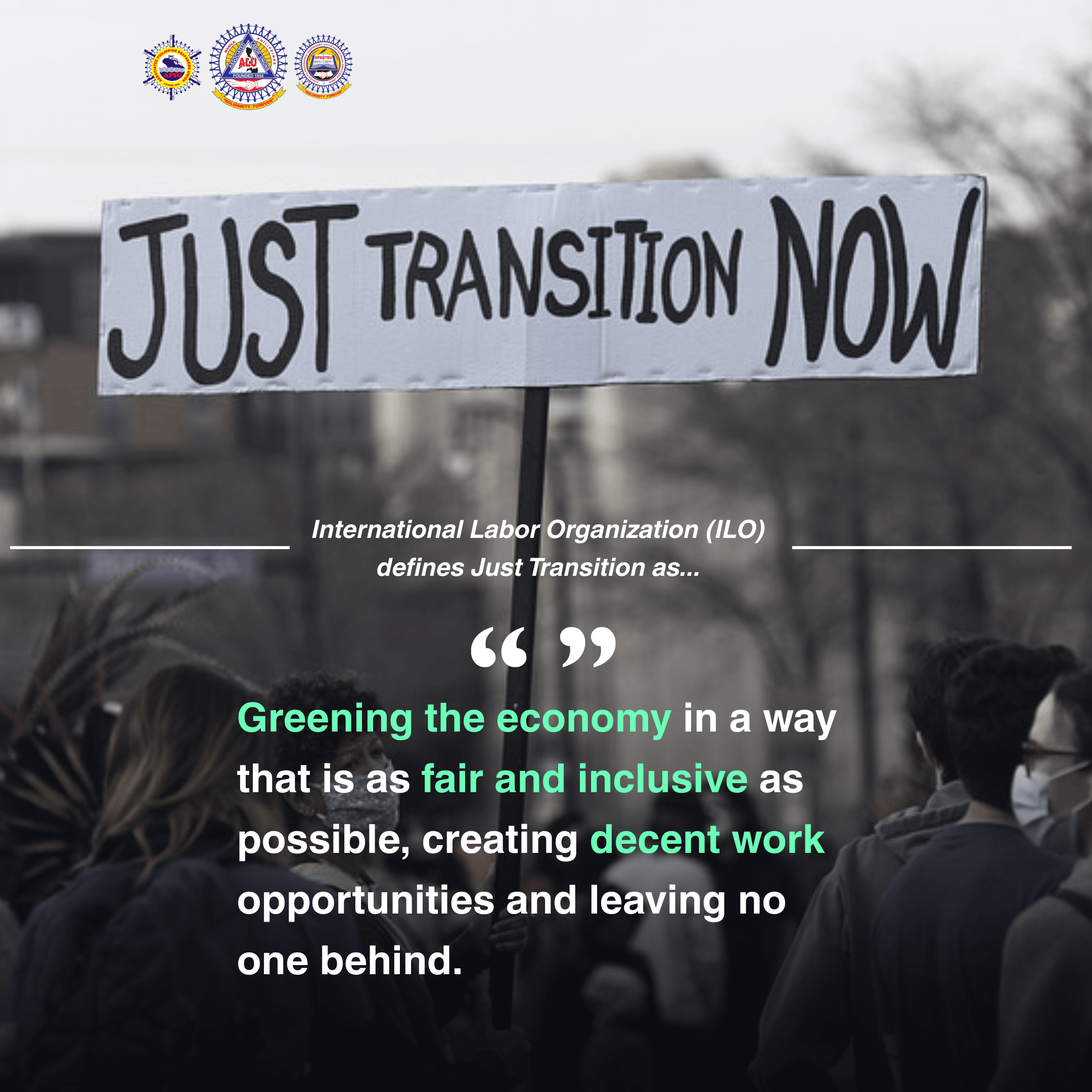
The International Labour Organization (ILO) defines Just Transition as “greening the economy in a way that is as fair and inclusive as possible to everyone concerned, creating decent work opportunities and leaving no one behind.” A Just Transition is not only about protecting the environment—it is also about protecting workers. Labor groups continue to emphasize that climate action should go hand-in-hand with decent work, social protection, and workers’ rights.
The Philippines remains vulnerable to climate change while still struggling to maximize its renewable energy potential. Although the country passed the Renewable Energy Act in 2008 and later the Green Jobs Act of 2016, labor advocates continue to stress that workers must remain at the center of these policies. A truly just transition means ensuring that workers have access to decent jobs, retraining opportunities, and participation in decisions that affect their livelihoods.
Today, discussions on Just Transition also include the growing use of artificial intelligence (AI) and automation in workplaces. AI technologies are now being used in healthcare, education, transportation, manufacturing, and customer service industries. In the Philippines, this presents both opportunities and risks for workers. While AI can improve efficiency and create demand for new digital skills, it can also replace repetitive jobs and increase pressure on workers through stricter monitoring systems.
For labor groups, a Just Transition means that workers should never be left behind during environmental and technological changes. Governments, employers, and industries must ensure that workers are supported through skills training, social protection, decent working conditions, and meaningful consultation. Any transition affecting workers’ livelihoods should involve workers themselves in the decision-making process.
Ultimately, a Just Transition is about building a future that is not only greener and more modern, but also fairer and more humane. As the Philippines continues to face climate change, digitalization, and economic transformation, labor organizations continue to call for policies that protect workers and ensure that progress benefits everyone—not just industries and corporations.